
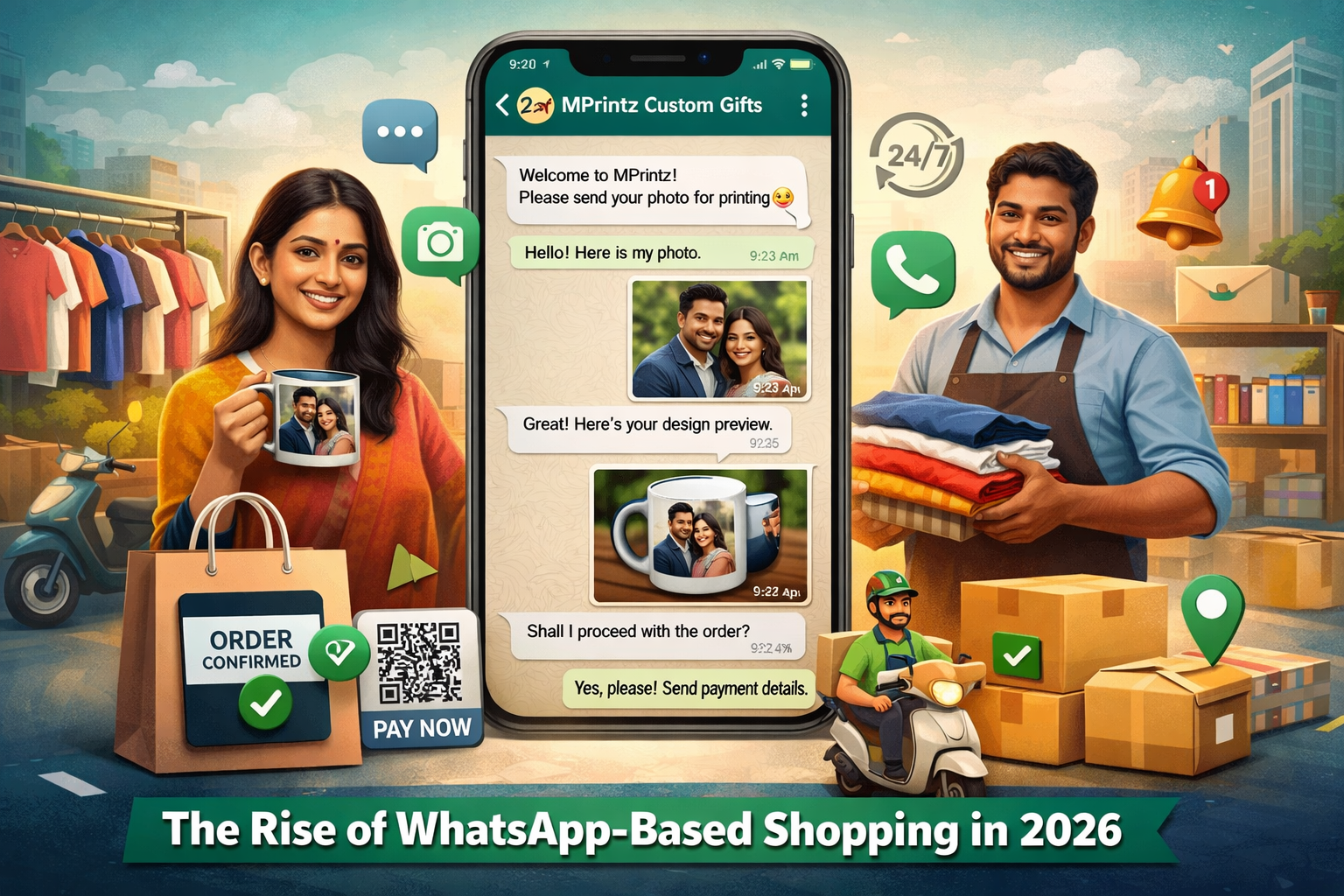
The Rise WhatsApp-Based Shopping in 2026
The Shift from Websites to Conversations
In 2026, the way people buy products online has changed more in the last five years than in the previous twenty. Websites, apps, and complicated e-commerce checkouts are slowly being replaced by something far simpler and far more human: conversations. And at the center of this change stands one platform that almost every Indian uses daily — WhatsApp.
For businesses like MPrintz, which deal with customized products, personal designs, and customer-specific orders, this shift is not just a trend. It is a revolution.
Customers no longer want to browse endless pages, fill out forms, upload images, wait for emails, or struggle with support tickets. They want to send a message, get a reply, share a photo, approve a design, and place an order — all in one place. WhatsApp has become the new digital marketplace.
From E-Commerce to “C-Commerce”
In 2026, experts call this model C-Commerce, or Conversational Commerce. Instead of clicking buttons, people talk. Instead of reading FAQs, they ask questions. Instead of browsing catalogs, they receive personalized suggestions.
WhatsApp has become the strongest platform for this because:
- It is already installed on almost every smartphone
- People trust it
- It feels personal
- It supports images, payments, catalogs, voice notes, and automation
For Indian customers especially, this feels more natural than using websites.
People don’t say “I will visit your website.”
They say, “WhatsApp me the details.”
That one sentence tells you everything about where commerce is going.
Why Traditional Websites Are Losing Power
In 2018–2022, websites were the center of online selling. But by 2026, they are slowly becoming support tools rather than the main sales engine.
Here’s why:
- Websites feel cold and robotic
People don’t feel comfortable entering personal data or uploading photos on unfamiliar websites. - Checkout is complicated
Add to cart, login, OTP, payment gateway, address form — too many steps. - No human connection
If something goes wrong, people feel stuck.
WhatsApp removes all of this.
One message. One chat. One person helping you.
That simplicity converts far more visitors into buyers.
India’s Love for WhatsApp
India is WhatsApp’s strongest market in the world. By 2026, it is not just a messaging app — it is a business platform, a payment system, a customer service desk, and a shopping mall.
Small businesses, local shops, corporate suppliers, and even big brands now use WhatsApp to:
- Show products
- Take orders
- Collect payments
- Send updates
- Handle complaints
- Build customer relationships
In many cities, customers don’t even ask for websites anymore. They directly ask for the WhatsApp number.
This behavior is especially powerful in custom printing and gifting, where customers need to:
- Send logos
- Share photos
- Explain their requirement
- Approve designs
A website cannot do this easily. WhatsApp can.
The Perfect Match for Custom Printing
Custom printing is not like selling a fixed product. Every order is different. One customer wants a logo on a mug. Another wants a photo on a cushion. A company wants 500 branded hoodies. A school wants certificates.
This requires conversation, not clicks.
WhatsApp allows:
- Real-time communication
- Easy sharing of designs
- Quick approvals
- Personal support
This is why businesses like MPrintz grow faster when they use WhatsApp as their primary sales channel.
Customers feel like they are talking to a real company, not a machine.
Trust is the New Currency
In 2026, trust is more valuable than price. With so many fake sellers and online scams, customers prefer to buy from businesses they can talk to.
A WhatsApp chat gives:
- Profile picture
- Business name
- Chat history
- Human replies
This creates a feeling of safety.
When MPrintz chats with a customer, shares sample designs, and gives updates, the customer feels confident. That confidence turns into payment.
What This Means for MPrintz
This shift is not a threat — it is a huge opportunity.
MPrintz is perfectly positioned for WhatsApp-based selling because:
- It deals with customized products
- It works with bulk and corporate orders
- It needs customer interaction
- It already uses digital design previews
In 2026, the printing businesses that win will not be the ones with the best websites. They will be the ones with the best conversations.








Add comment